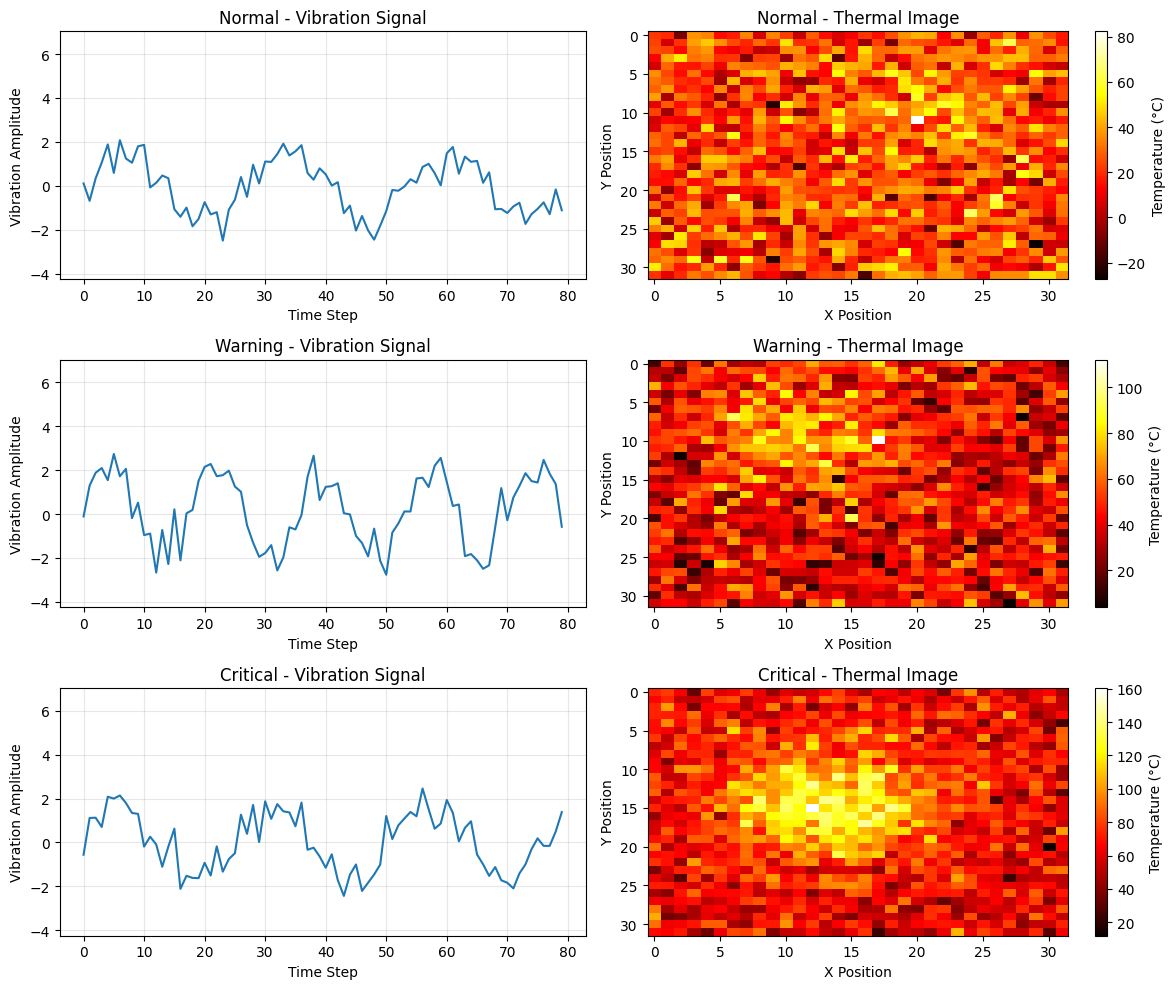
def generate_synthetic_data(n_samples=500, ts_length=80, img_size=(32, 32)):
    """
    Generate synthetic multimodal data for equipment monitoring.

    This function creates ambiguous data where each modality alone is insufficient,
    but combining both provides better classification. Two types of issues are simulated:
    - Type A: High vibration (looks critical) but low temperature (actually warning)
    - Type B: Low vibration (looks normal) but high temperature (actually warning)

    Returns:
        time_series: vibration sensor data (n_samples, ts_length)
        images: thermal camera data (n_samples, img_size[0], img_size[1])
        labels: equipment health status (n_samples,)
    """
    time_series = []
    images = []
    labels = []

    for _ in range(n_samples):
        # Randomly assign a health status Normal, Warning, Critical
        label = np.random.choice([0, 1, 2], p=[0.45, 0.40, 0.15])
        labels.append(label)

        ambiguous_type = None

        if label == 1 and np.random.random() < 0.85:
            ambiguous_type = np.random.choice(["A", "B"])
        elif label == 0 and np.random.random() < 0.40:
            ambiguous_type = "slight_elevation"  # Many normals look elevated
        elif label == 2 and np.random.random() < 0.35:
            ambiguous_type = "one_misleading"  # Many criticals look normal in one modality

        # Generate time series with high overlap - amplitude and frequency ranges heavily overlap
        if label == 0:  # Normal
            if ambiguous_type == "slight_elevation":
                # Overlaps strongly with warning
                t = np.linspace(0, np.random.uniform(5, 8) * np.pi, ts_length)
                ts = np.random.uniform(1.2, 1.6) * np.sin(t) + np.random.normal(0, 0.5, ts_length)
                base_temp = 25 + np.random.normal(0, 7)
            else:
                t = np.linspace(0, np.random.uniform(4, 7) * np.pi, ts_length)
                ts = np.random.uniform(0.8, 1.3) * np.sin(t) + np.random.normal(0, 0.5, ts_length)
                base_temp = 22 + np.random.normal(0, 8)
        elif label == 1:  # Warning - extremely ambiguous in time series
            if ambiguous_type == "A":
                # Type A: Looks critical in vibration but moderate temperature
                t = np.linspace(0, np.random.uniform(9, 12) * np.pi, ts_length)
                ts = np.random.uniform(1.8, 2.3) * np.sin(t) + np.random.normal(0, 0.6, ts_length)
                # Add spikes that make it look critical
                spike_indices = np.random.choice(ts_length, size=np.random.randint(3, 6), replace=False)
                ts[spike_indices] += np.random.uniform(1, 2.5, size=len(spike_indices))
                base_temp = 40 + np.random.normal(0, 9)  # Moderate temp distinguishes it
            elif ambiguous_type == "B":
                # Type B: Looks normal in vibration but elevated temperature
                t = np.linspace(0, np.random.uniform(4, 7) * np.pi, ts_length)
                ts = np.random.uniform(1.0, 1.4) * np.sin(t) + np.random.normal(0, 0.5, ts_length)
                base_temp = 52 + np.random.normal(0, 9)  # High temp distinguishes it
            else:
                # Regular warning - still overlaps with both normal and critical
                t = np.linspace(0, np.random.uniform(6, 9) * np.pi, ts_length)
                ts = np.random.uniform(1.3, 1.8) * np.sin(t) + np.random.normal(0, 0.6, ts_length)
                base_temp = 43 + np.random.normal(0, 10)
        else:  # Critical
            if ambiguous_type == "one_misleading":
                # One modality looks much less critical
                if np.random.random() < 0.5:
                    # Lower vibration (overlaps with warning/normal) but very high temp
                    t = np.linspace(0, np.random.uniform(6, 9) * np.pi, ts_length)
                    ts = np.random.uniform(1.4, 1.9) * np.sin(t) + np.random.normal(0, 0.6, ts_length)
                    spike_indices = np.random.choice(ts_length, size=np.random.randint(1, 3), replace=False)
                    ts[spike_indices] += np.random.uniform(0.5, 1.5, size=len(spike_indices))
                    base_temp = 70 + np.random.normal(0, 8)  # Temperature is clearly critical
                else:
                    # Higher vibration but moderate temp (overlaps with warning)
                    t = np.linspace(0, np.random.uniform(10, 13) * np.pi, ts_length)
                    ts = np.random.uniform(1.9, 2.3) * np.sin(t) + np.random.normal(0, 0.7, ts_length)
                    spike_indices = np.random.choice(ts_length, size=np.random.randint(4, 7), replace=False)
                    ts[spike_indices] += np.random.uniform(1.5, 3, size=len(spike_indices))
                    base_temp = 58 + np.random.normal(0, 8)  # Moderate temp
            else:
                # More typical critical but with variability
                t = np.linspace(0, np.random.uniform(10, 14) * np.pi, ts_length)
                ts = np.random.uniform(1.8, 2.4) * np.sin(t) + np.random.normal(0, 0.7, ts_length)
                spike_indices = np.random.choice(ts_length, size=np.random.randint(4, 8), replace=False)
                ts[spike_indices] += np.random.uniform(1.5, 3.5, size=len(spike_indices))
                base_temp = 68 + np.random.normal(0, 10)

        time_series.append(ts)

        # Generate thermal image with HIGH ambiguity to make classification harder
        # Much more overlap between classes to reduce image-only accuracy
        img = np.random.normal(base_temp, 15, img_size)  # Even higher noise

        # Add hot spots with heavily overlapping patterns to create strong ambiguity
        if label == 0:  # Normal - but frequently looks like warning or critical
            if np.random.random() < 0.55:
                # Often looks like warning or critical
                n_hotspots = np.random.randint(2, 4)
                hotspot_intensity_factor = np.random.uniform(1.0, 1.8)
                hotspot_base = 18
            else:
                n_hotspots = np.random.randint(1, 3)
                hotspot_intensity_factor = np.random.uniform(0.7, 1.3)
                hotspot_base = 12
        elif label == 1:  # Warning - highly ambiguous, overlaps heavily with both
            if np.random.random() < 0.45:
                # Looks like normal
                n_hotspots = np.random.randint(1, 3)
                hotspot_intensity_factor = np.random.uniform(0.7, 1.3)
                hotspot_base = 14
            elif np.random.random() < 0.45:
                # Looks like critical
                n_hotspots = np.random.randint(2, 4)
                hotspot_intensity_factor = np.random.uniform(1.5, 2.2)
                hotspot_base = 28
            else:
                n_hotspots = np.random.randint(2, 3)
                hotspot_intensity_factor = np.random.uniform(1.0, 1.6)
                hotspot_base = 20
        else:  # Critical - but often looks like warning or normal
            if np.random.random() < 0.50:
                # Frequently looks like warning or normal
                n_hotspots = np.random.randint(2, 3)
                hotspot_intensity_factor = np.random.uniform(1.1, 1.7)
                hotspot_base = 22
            else:
                n_hotspots = np.random.randint(2, 4)
                hotspot_intensity_factor = np.random.uniform(1.6, 2.4)
                hotspot_base = 30

        for _ in range(n_hotspots):
            x, y = np.random.randint(6, img_size[0] - 6), np.random.randint(6, img_size[1] - 6)
            intensity = hotspot_base + np.random.uniform(5, 25) * hotspot_intensity_factor  # More variable intensity
            # Create a Gaussian hot spot with more variable size
            sigma = np.random.uniform(2.0, 7.0)  # Wider range for hotspot size
            xx, yy = np.meshgrid(np.arange(img_size[0]), np.arange(img_size[1]))
            hotspot = intensity * np.exp(-((xx - x) ** 2 + (yy - y) ** 2) / (2 * sigma**2))
            img += hotspot.T

        images.append(img)

    return np.array(time_series), np.array(images), np.array(labels)


# Generate data
ts_data, img_data, labels = generate_synthetic_data()

print(f"Time series shape: {ts_data.shape}")
print(f"Images shape: {img_data.shape}")
print(f"Labels shape: {labels.shape}")
print()
print("Class distribution:")
print(f"  Normal: {np.sum(labels == 0)} ({np.sum(labels == 0) / len(labels) * 100:.1f}%)")
print(f"  Warning: {np.sum(labels == 1)} ({np.sum(labels == 1) / len(labels) * 100:.1f}%)")
print(f"  Critical: {np.sum(labels == 2)} ({np.sum(labels == 2) / len(labels) * 100:.1f}%)")